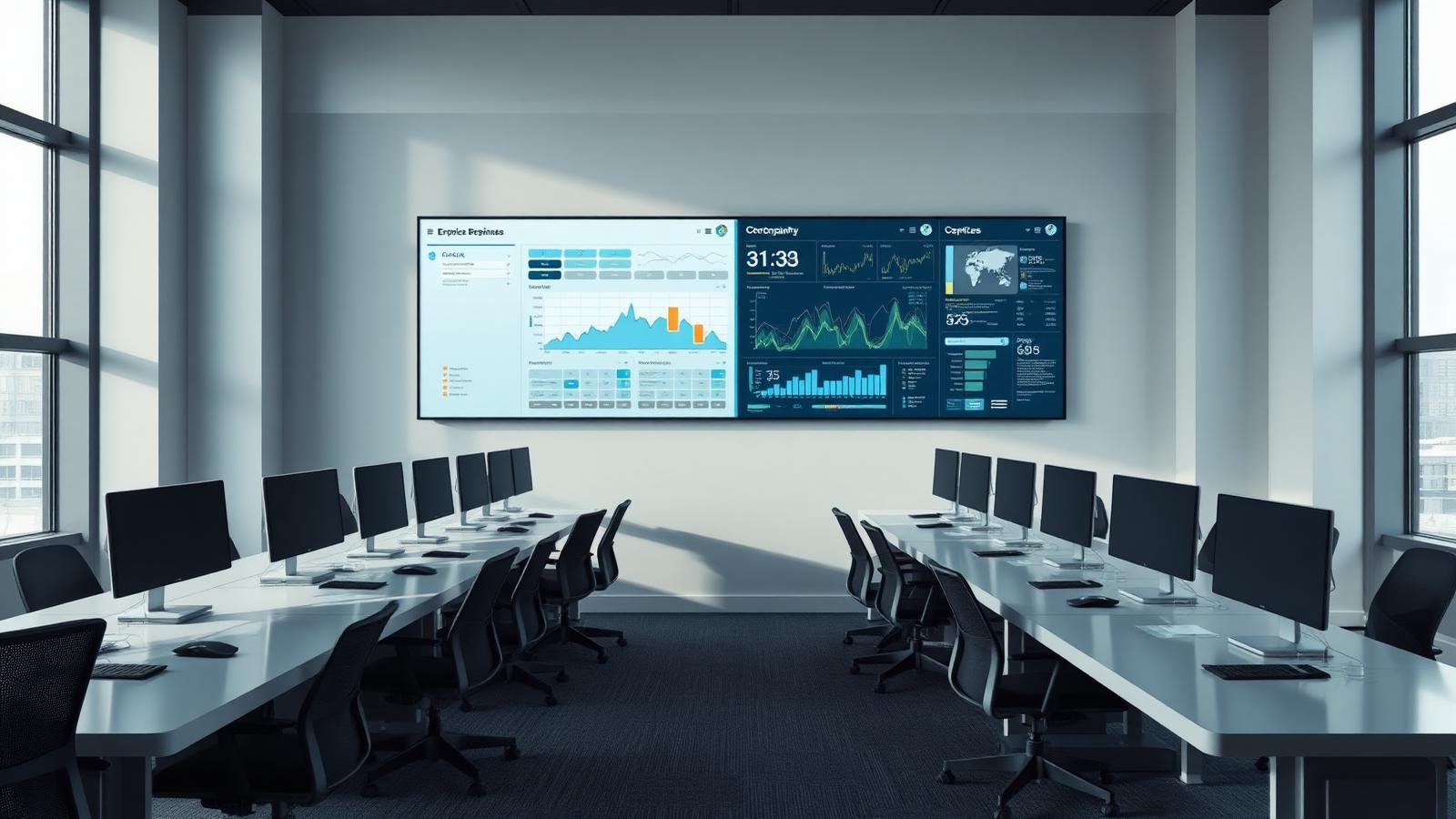
Bright enterprise operations workspace with workstations and a wall-mounted performance dashboard.

Insurance and Enterprise Operations

From Manual Handoffs to Real-Time Operations

Modernizing enterprise insurance workflows to cut approval turnaround time by 50% and increase user satisfaction by 90%.

50%
Reduction in approval turnaround time
15%
Reduction in staffing for the same approval volume
23%
Decrease in internal email traffic
90%
Increase in user satisfaction

The Challenge

A large insurance enterprise relied on manual processes to move critical approvals through underwriting, claims, legal, and compliance.

Requests passed between people and departments through email, spreadsheets, and other disconnected processes. Employees spent substantial time forwarding information, requesting updates, locating decision-makers, and determining where individual approvals stood.

As volume increased, maintaining these workflows required additional administrative capacity. Skilled underwriting, claims, legal, and compliance personnel were spending time managing handoffs instead of applying their expertise to higher-value work.

The same fragmentation affected internal communication. Distributed teams and business units relied heavily on email for routine coordination, creating crowded inboxes, delayed responses, duplicated conversations, and limited visibility across operational functions.

The company's technology operations function faced an additional problem. It lacked real-time performance information needed to identify constraints, compare priorities, and determine where improvement resources should be invested.

These appeared to be three separate problems:

  • Slow and labor-intensive approval workflows
  • Inefficient internal communication
  • Limited visibility into technology operations

Our evaluation found that they shared the same underlying cause. The company's operating processes had not evolved to match the scale and complexity of the enterprise.

Our Approach

United Ops assembled a team of workflow automation, insurance operations, technology, process-improvement, data, and change-management experts to work directly with leaders across underwriting, claims, legal, compliance, technology operations, and internal communications.

The engagement began with an evaluation of how requests, decisions, information, and performance data moved across the organization.

Our experts assessed:

  • How approval requests were initiated and documented
  • Where manual handoffs occurred
  • How requests were routed between departments
  • Where approvals stalled or required follow-up
  • How employees determined the status of pending work
  • Which activities required professional judgment and which could be automated
  • How email was being used for routine coordination
  • How teams collaborated across business units and locations
  • What technology operations data was available
  • How performance was measured and reported
  • How leaders prioritized technology investments and corrective action

The objective was not simply to digitize existing processes. It was to determine which processes should be eliminated, redesigned, automated, or managed differently before introducing new technology.

What Our Experts Found

The manual approval process created work at every stage.

Employees were required to receive requests, verify information, identify the appropriate reviewer, forward documentation, monitor responses, answer status questions, and manually move completed decisions to the next person.

This produced several connected problems:

  • Approval progress depended heavily on individual follow-up
  • Requestors had limited visibility into status
  • Managers lacked a consistent view of workload and bottlenecks
  • Skilled personnel were performing avoidable administrative work
  • Delays accumulated as requests moved between functions
  • Increasing volume created pressure to add headcount
  • Performance data was fragmented or available only after the fact

Email had become the default coordination system for much of the organization. Important conversations were difficult to separate from routine traffic, information remained trapped in individual inboxes, and distributed teams could not easily see work occurring elsewhere.

Within technology operations, the lack of real-time analytics made it difficult to distinguish isolated problems from recurring performance patterns. Leaders could see outcomes after they occurred but had limited ability to intervene while performance was changing.

The company did not simply need faster technology. It needed a more modern operating system for moving work, sharing information, and managing performance.

What Our Experts Rebuilt

Working directly with company leaders and functional teams, United Ops experts implemented three connected improvements.

Approval workflow automation. Our experts designed and built a mobile and web application to automate critical approval workflows across underwriting, claims, legal, and compliance.

The redesigned process established a consistent path from request to resolution, including:

  • Standardized request submission
  • Automated routing to the appropriate decision-maker
  • Clear ownership at each stage
  • Centralized supporting information
  • Real-time status visibility
  • Reduced dependence on manual follow-up
  • Better tracking of processing time and bottlenecks
  • A consistent record of decisions and completed approvals

Automation removed administrative steps while preserving the professional judgment, legal review, and compliance controls required for each decision. The application did not replace subject-matter expertise. It allowed that expertise to be applied without the surrounding manual overhead.

Communication modernization. United Ops experts led the transition to Slack as the company's primary internal collaboration platform. The effort extended beyond installing a new communication tool. It included redesigning how teams communicated across departments and operating functions.

Teams established clearer practices for:

  • Operational coordination
  • Department and project communication
  • Cross-functional problem-solving
  • Escalation of time-sensitive issues
  • Sharing information across distributed groups
  • Separating routine collaboration from formal documentation
  • Reducing unnecessary email chains and duplicated updates

The change gave employees more immediate access to relevant conversations and reduced the amount of operational coordination buried inside individual inboxes.

Technology operations modernization. United Ops assembled Six Sigma, ITIL, analytics, data-management, and technology operations experts to evaluate and rebuild the broader performance-management framework.

The redesigned operating model introduced:

  • Defined performance measures
  • Consistent data-management practices
  • Real-time operational analytics
  • Greater visibility into service and process performance
  • Structured identification of performance gaps
  • Clearer ownership of corrective action
  • Better information for prioritizing technology investments
  • A more disciplined framework for continuous improvement

This shifted technology operations from retrospective reporting toward active performance management. Leaders gained the ability to see where performance was changing, determine which problems required intervention, and allocate resources using current operating evidence.

Supporting Adoption

Implementation was not treated as complete when the application, collaboration platform, and analytics capabilities became available.

United Ops experts worked with the relevant teams to support adoption, establish new operating practices, and ensure that employees understood how the systems should be used.

This was critical because new technology does not improve performance unless the surrounding behaviors and management routines change with it.

The engagement connected technical implementation with:

  • Process ownership
  • User training and adoption
  • Communication standards
  • Leadership expectations
  • Performance measurement
  • Continuous-improvement practices

The objective was to create lasting operational change, not simply deploy new tools.

The Results

The combined modernization effort produced measurable improvements in processing speed, workforce efficiency, communication, and user experience.

MeasureResult
Critical approval turnaround time50% reduction
Staffing required to manage the same approval volume15% reduction
Internal email traffic23% decrease
User satisfaction following operational modernization90% increase

Approval automation cut turnaround time in half while reducing the staffing capacity required to manage the same volume by 15%.

The communication-platform transition reduced email traffic by 23%, allowing more routine collaboration and coordination to occur in shared, visible channels.

Following the Six Sigma and ITIL-driven modernization of technology operations, user satisfaction increased by 90%.

The Business Impact

The engagement created value beyond the individual performance measures. For the company, the new operating system supported:

  • Faster underwriting, claims, legal, and compliance decisions
  • Greater capacity without proportional headcount growth
  • Better visibility into the status of critical approvals
  • Less time spent requesting updates and managing handoffs
  • More productive use of specialized professional talent
  • Faster collaboration across distributed teams
  • Reduced dependence on internal email
  • Real-time visibility into technology operations
  • Better prioritization of improvement and investment decisions
  • A more consistent user experience across operational functions

The 15% reduction in staffing requirements represented more than administrative efficiency. It created the opportunity to redirect capacity toward underwriting quality, claims resolution, compliance, customer service, and other work requiring professional expertise.

Why the Engagement Worked

The results did not come from treating workflow automation, collaboration, and performance analytics as separate technology projects.

United Ops assembled experts capable of evaluating how work moved across the entire organization and then connected the three initiatives through one operating model.

Several factors were critical:

  • Evaluating the process before automating it
  • Removing unnecessary handoffs instead of digitizing them
  • Preserving professional judgment and control requirements
  • Giving requestors and leaders real-time workflow visibility
  • Establishing communication practices alongside the new platform
  • Connecting Six Sigma and ITIL methods with real-time operating data
  • Supporting user adoption as part of implementation
  • Measuring operational and user outcomes after deployment

The company did not simply acquire new applications. It developed a faster, more visible, and more scalable way to operate.

The United Ops Engagement Model

United Ops assembles the right combination of operational leaders, workflow specialists, technology experts, data professionals, process-improvement practitioners, and change-management resources around the specific business outcome.

Our experts evaluate the relevant processes, technologies, management systems, and organizational practices before prescribing a solution.

We then work directly with company leadership and functional teams to redesign the operation, implement the appropriate technology, establish performance visibility, and support the behavioral changes required to sustain the improvement.

When manual processes consume professional capacity, the answer is rarely automation alone. The process, technology, data, and operating model must work together.

Simplify the work. Automate the flow. Manage performance in real time.

Are manual handoffs consuming your professional capacity?

If skilled people spend their time chasing approvals and status, the process usually needs redesigning before anything gets automated. Let's evaluate how work actually moves.

Related case studies

All case studies
Wide aisle of a modern manufacturing plant with material staged alongside the production line.

Industrial Manufacturing

From Firefighting to Flow

Recurring stoppages and rising unit costs looked like an equipment problem. The real constraint was material flow, frontline leadership, and daily management discipline.

63%
Productivity increase
39%
Lower cost per kilogram
15 pts
OEE improvement
Read the case study
Precision electric drive assembly line with automated stations in a clean production hall.

Automotive Electronics and eMobility

From Fragmented Launches to Repeatable Performance

Dashboards already showed the losses. What the portfolio lacked was a management system able to turn that data into coordinated action across R&D, engineering, and manufacturing.

59% to 84%
Average portfolio OEE
10+
Projects delivered
120+
Person organization built
Read the case study